

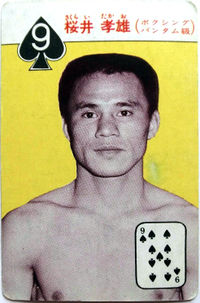
Name: TAKAO SAKURAI
Born: Sawara, Japan 25 September 1941
Died: Died Tokyo, Japan 10 January 2012
Career: 1965 to 1970
Record: 32 fights, 30 wins (4 by KO/TKO), 2 losses (1 by KO/TKO).
Division Bantamweight
Stance: Southpaw
Titles: OPBF bantamweight champion
Major Contests
Scored wins over: Toyoharu Mizuta (twice), Pat Gonzalez. Katsutoshi Aoki, Yoshio Nakane, Tetsuya Yamagami, Ushiwakamura Harada, Katsuyoshi Takayama*,
Lost against: Lionel Rose **, Ruben Olivares **,
**Past/ future holder of a version of a world title
* Unsuccessful challenger for a version of a world title
Takao Sakurai’s Story
In October 1964 in Tokyo Sakurai made history by becoming the first Japanese boxer to win a gold medal at the Olympic Games. Born in Sarawa City Sakurai attended Sarawa City First High School as a part-time student joining the boxing club. The high school had no boxing coach which was attractive to Sakurai as he was able to work on his own learning as he went along and developing a style based on speed and clever defence. He built his own punchbag and had no proper boxing boots He kept his involvement in boxing from his parents but as he became more successful, such as winning the Inter-National High School championship in 1960, that was no longer possible but he promised he would only box whilst he was a student.
After high school he was greatly in demand with the Universities in Japan who wanted a strong boxing team. Sakurai chose the Chuo University Boxing Club, the number one university for boxing in Japan at the time, which had won the university championship four times in a row and was overwhelmingly strong. Included in its ranks was Kiyoshi Tanabe who is credited with scoring two wins over Sakurai. Japan first competed in boxing at the 1928 Amsterdam Olympics and Tanabe became the first Japanese boxer to win an Olympic medal when he won a bronze at the 1960 Olympic Games in Rome in 1960.
Sakurai now dominated the bantamweight ranks in Japan winning the All-Japan title in 1963. With the 1964 Olympics to be held in Tokyo Sakaria took part in some international bouts to gain experience in facing non-domestic opposition. He cleared his way from a Japanese standpoint by beating Shuta Yoshida in a pre-Olympic tournament in October 1963. He was less successful in January 1964 losing to Australian Billy Booth in Sydney. Booth beat Lionel Rose in the final of the Australian championships and was selected to represent Australia in Tokyo but in his first bout was knocked out in three rounds by Cuban Fermin Espinosa and Espinosa was forced out through injury in his quarter-final bout. Sakurai faced Britain’s Brian Packer and won on points and then defeated Ghanaian Isaac Cassis Aryee of Ghana and Nicolae Puiu of Romania in the quarter finals to guarantee him a medal-but which colour? He was the only Japanese fighter left in the tournament and when he beat the Latin American champion Washington Rodriguez in the semi-final the hopes of a gold medal for Japan rested on his final fight against South Korean Jeong Sin-Jo. There was also plenty of interest in the heavyweight final where hard-punching American Joe Frazier was competing. Sakurai had won his four fights on points and Frazier had scored two first round wins and a second round win on his way to the final. Sakurai gained hero status as he beat Sin-Jo to win Japan’s first boxing gold medal and in fact Sakurai outperformed Frazier. Joe outpointed German Hans Huber and Takao floored Sin-jo four times and stopped him in the second round.
There was great rejoicing in Japan but the honeymoon did not last long. Before the Olympics Sakurai had been training at the Misako Boxing Gym-a professional Gym. There was no interaction between amateurs and professionals in Japan and if it had come to light that Sakurai had been training at the Misako gym he would probably have lost his place on the team for the Olympics. He had been offered a job at the Chuo University and had said he would remain at the university and not turn professional. When it was reported he had signed
with the Misako Gym and was to fight as a professional the university expelled him from the university boxing club and his achievements were expunged from the university records.
Sakurai left the amateur ranks with a record of 138 wins (124 by KO/TKO) 13 losses.
He won his first professional fight, a six rounder in Tokyo on 3 June 1965, against Atom Hatai and then went straight to ten round fights beating Akio Furuki in August. By the end of 1967 he had scored 19 victories including wins over former bantamweight title challenger Katsutoshi Aoki, world rated Yoshio Nakane (who beat 54-2 Jesus Pimentel in his next fight)and Tetsuya Yamagami who had earlier drawn with Chartchai Chionoi. Sakurai extended his run of wins to 22 and landed a title shot against Lionel Rose for the WBA and WBC bantamweight titles held in Tokyo in July 1968.
Sakurai’s fighting philosophy was “hit but don’t get hit”. He was an accomplished defensive boxer with great footwork plenty of speed and tremendous reflexes. He suggested he could sense an opponent’s punch before it was thrown. As expected he used those defensive tactics against Roise in the first round. What was not expected was that Sakurai should floor Rose with a straight left in the second round. Rose was up quickly and it was difficult to discern how badly he had been hurt. That became irrelevant as Sakurai could not shake off his defensive mind set and failed to follow up that success and Rose was battling back at the bell. The fight was close and Rose retained the titles on a majority decision with on scores of 72-70, 72-71 and 72-72. There was no immediate return shot for Sakurai but in May 1969 he faced Ruben Olivares in title eliminator. At the time Olivares had a 50-0-1 record made up of 48 wins by KO/TKO, one points win, one win by disqualification and a draw. With regard to the draw Olivares told me many years later that he slipped in the shower and injured an arm in training and fought German Bastidas using only one arm.
Against Olivares Sakurai boxed with his customary skill but the relentless body attacks from Olivares wore him down. In the sixth Olivares sent Sakurai into, down almost out through the bottom rope. Sakurai was sitting on the ring apron with one leg draped over the bottom rope. He was struggling and the referee counted to seven then, seeing Sakurai was not going to manage to get back into the ring, incredibly the referee grasped Sakurai’s arm and pulled him into the ring and upright and let the fight continue:
He did Sakurai no favours as Olivares promptly floored Sakurai twice more and the referee waived the fight off.
Sakurai had five more fights winning them, collecting the OPBF title and making one defence before retiring in November 1970. You might have though winning that first ever gold medal would have made Sakurai a national idol and it did with most fans but some amateur adherents saw him as a traitor for turning professional and some professionals criticised his style as being too amateurish!
Japan first entered Olympic boxing in 1928 and it was 36 years before Sakurai won his gold medal in 1964 and it would be 48 years before another Japanese boxer won a gold medal at the Olympic Games a feat achieved by Ryota Murata in London in 2012.
After retirement Sakurai worked for a while at the Misako Gym, ran a coffee shop and worked in real estate. He returned to boxing in 1994 opening a gym “One Two Sports Club” and he became its first President. He was diagnosed with oesophageal cancer in November 2011 and on January 10, 2012.