

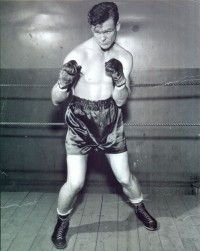
 Name: “IRISH BOB MURPHY”.
Birth name: Edwin Lee O’Connerty
Born: 22 July 1922
Died: 1 August 1961 aged 39
Career: 1945 to 1954
Record: 78 fights, 65 wins (56 by KO/TKO), 11 losses (4 by KO/TKO), 2 draws
Division: Light Heavyweight
Stance: Southpaw
Titles: California State light heavyweight
Major Contests
Scored wins over: Milo Savage, Eddie Cotton*, Lloyd Marshall, Dave Whitlock (twice). Kenny Watkins, Dan Bucceroni, Jake LaMotta**
Lost against: Kenny Watkins, Clarence Henry, Harry Matthews. Joey Maxim**, Jake LaMotta**, Joey DeJohn, Jimmy Welch, Bobby Williams (twice).
**Past/ future holder of a version of a world title
* Unsuccessful challenger for a version of a world title
Bob Murphy’s Story
Born Edward Lee Conarty in Flagler, Colorado Murphy’s grandfather was born in Ireland with the surname O’Conarty, but the family later went by Conarty in the USA. Conarty joined the US Navy at the age of 18 and was assigned to the aircraft carrier the USS Lexington. The Lexington was damaged by Japanese aircraft in the Battle of the Coral Sea and subsequently scuttled. Murphy survived and was assigned to the battleship the USS Alabama and saw plenty of action later in the Pacific. During his time in the Navy Murphy was a member of the boxing teams of both the Lexington and the Alabama. It was said that he never lost a fight during his naval service and gained a reputation as a fearsome puncher.
When he decided to try boxing as a professional he legally changed his name to Robert and with his family history decided he had to add “Irish” as a nickname due to his family ties to Ireland.
He had his first professional fight in August 1945 in San Diego beating Ray Raymond on points and scored four more wins before losing on a cut against Homer McGrew in November 1945. He was being trained by former middleweight champion Gorilla Jones and went unbeaten in his next 28 fights winning 22 inside the distance. One of his victims had been Kenny Watkins but it was Watkins who ended Murphys unbeaten run with a majority decision in April 1949. During that unbeaten run Murphy had advanced to ten round bouts and had his only fight out of the USA knocking out Pete Rodriguerz in Mexicali.
After the loss to Watkins Murphy again showed the power which made him such a big drawcard scoring ten consecutive inside the distance wins beating future title challenger Eddie Cotton and Murderer’s Row’s Lloyd Marshall. That run of wins had seen Murphy rise to No 3 in the Ring Magazine light-heavyweight ratings.
He was a fighter who liked to stay busy and had had 14 fights in 1949 and had built his record to 41-2-1. Relative novice Clarence Henry with his 13-1-1 record looked no threat for their fight in February 1950 but Henry battered Murphy to defeat in six rounds. It was a huge setback for Murphy but he rebuilt with a run of 13 wins, all by KO/TKO, twice beating rated Dave Whitlock for the Californian State title and making his first appearance at Madison Square Garden (MSG)when knocking out Jimmy Beau.
Harry Matthews had climbed to the No 1 spot in the light heavyweight ratings with an unbeaten run of 35 fights and had only three losses in his 71 fights. The loss to Henry had cast Murphy into the wilderness but a win over Matthews would guarantee a title shot. Power and durability were Murphy’s strengths but they were not enough against a boxer with the talent of Matthews and when they clashed at MSG in March 1951 Matthews won a wide unanimous decision. That seemed to spell the end of any hopes Murphy had of a world title fight.
He proved he had one more rebound in him as just two weeks after the loss to Matthews Murphy was back at MSG facing 34-1 Dan Bucceroni. It was a duel of punchers with Bucceroni having scored 28 of his 34 wins inside the distance and Murphy winning 23 of his last 24 fights by KO/TKO. Murphy almost ended it in the first as he put Bucceroni down with a left hook, Bucceroni survived and fought back hard but Murphy
absorbed everything Bucceroni threw at him and gradually wore him down and stopped him in the fifth-one of only two inside the distance losses suffered by Bucceroni in his 56 fight career.
Murphy really needed one more big win to get his long awaited title shot and he was presented with that opportunity by a match with Jake LaMotta at Yankee Stadium in June 1961. LaMotta had lost the World middleweight title being stopped in 13 rounds by Sugar Ray Robinson and was looking to get a shot at the light heavyweight title. The pair fought a brutal inside fight, a war of attrition with neither willing to take a step back, and Murphy won when LaMotta could not come out for the eighth round. One of only four times LaMotta was beaten inside the distance.
Murphy got his title shot against champion Joey Maxim at MSG on 22 August 1951. In May Maxim had been outclassed by Ezzard Charles in a challenge for the NBA heavyweight title and wins over Bucceroni and La Motta saw Murphy installed as a 5/12 favourite. Maxim outboxed Murphy all the way and Murphy said he would not have been able to lay a glove on Maxim even if they had fought in a phone booth.
Murphy scored wins over some very ordinary opposition and then fought LaMotta again in June 1952. The fight at the Detroit Olympia Stadium drew a crowd of 16,000 and it was every bit as savage as the first fight. Murphy was virtually out on his feet over the last two rounds and LaMotta scored a close but unanimous points victory by 51-49 twice and 55-45.
That was one fight too many for Murphy. He had made every fight a war and he paid for that as he fell apart and was a shell of the fighter he had been. A run of four losses was followed in April 1954 by a draw with 1-6-1 Roger Wiley and that was the end of Muphy’s career.
His 56 (86.15%) wins by KO/TKO earned him a spot in the 2003 Ring Magazine’s list of the 100 greatest punchers of all time and his two fights with LaMotta are classics of courage (both can be seen on you tube). Murphy had an iron chin but was short on skill and came was well beaten by Maxim in his only shot at the title.
Tragically Murphy died at the age of 39 when he crashed into a lorry when riding his motorcycle and suffered a broken neck.