

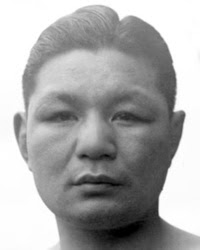
 Name: Tsuneo “Piston” Horiguchi
Born: 12 October 1914 Utsunomiya, Japan
Died: 24 October 1950 aged 36
Career: 1933 to 1950
Record: 183 fights, 142 wins (87* by KO/TKO), 26 losses (3 by KO/TKO), 15 draws.
Division: Featherweight, Lightweight, Middleweight
Stance: Orthodox
Titles: Japanese featherweight and middleweight champion, Orient featherweight champion***
Major Achievements
-Most fights for any Japanese boxer
-Most wins by KO/TKO by any Japanese boxer
-Only Japanese boxer the win both the national featherweight and middleweight titles
-Had 20 fights in 1946 a record number of fights in one year for a Japanese boxer
-Fought a draw with former world flyweight champion Emile Pladner in only his ninth fight.
Tsuneo Horiguchi’s Story
Although little known outside of Japan Horiguchi is a legendary figure in Japan and played an important part in the popularising of professional boxing in Japan. In a 17-year career as a professional he set Japanese records which will never now be beaten having had more fights-183-and scored more inside the distance wins-87-than any other Japanese boxer.
He was the son of a Police Chief and attended Moka Junior High School where he became the captain of the Judo Club. Yujiro Watanabe had set up the first Japanese boxing club/gym -Nippon Kento Club-in 1921. Initially it was a club for amateur boxers the first two Japanese boxers to fight at the Olympics, Fuji Okamoto and Kintaro Usui were cultivated by Watanabe’s Club and he was instrumental in the instigating of the all-Japan Shijin-o (Novice) tournament. Watanabe would come to be known as the father of boxing in Japan. Watanabe visited Moka in 1931 and he brought along a professional fighter. Horiguchi jumped at the chance to challenge the professional and Watanabe was impressed by Horiguchio’s enthusiasm. Horiguchi went on to attend Wasaeda University and joined Watanabe’s Japan Kento Club. With Watanabe as his manager Horiguchi turned professional and had his first fight on 3 March 1933 at 18.
Former world flyweight champion Emile Pladner was coming to the end of his long career and was reportedly suffering severe problems with his eyesight. He and two other French fighters travelled to Japan for a series of fights. An elimination tournament was organised by a newspaper to determine an opponent for Pladner. Horiguchi entered the tournament despite the 3 March contest being his only professional fight. He beat three other Japanese fighters and then stopped former Japanese featherweight champion Kaneo Nakamura in two rounds. A result that the newspaper described as “one of the greatest upsets in local ring history”. Horiguchi had one more obstacle to overcome and that was Pladner’s sparring partner Raoul Hughues. Horiguchi outpointed Hughues and met Pladner on 3 July in Tokyo with the result being a draw. Winning the tournament and drawing with Pladner gave Horiguchi’s career a huge lift.
Japan had sent their first fighters to the Olympic Games in 1928 but amateur boxing was not popular in Japan. In amateur boxing fights were stopped whenever a boxer suffered a bad cut or appeared badly shaken which did not fit with the warrior traditions of Japan. If knocked out, a boxer had obviously done his utmost, but if still standing, then the reasoning was that he could have done more. The “hit but don’t be hit” approach was both literally and metaphorically foreign to Japanese professional boxers.
Watanabe organized the Japan Boxing Association. This was essentially a guild, and to belong, gym owners had to pay quite a high fee. To recoup the fee promoters had to stage entertaining fights to draw the crowds, and lots of them.
Horiguchi’s approach was to adopt a system based on the principle that the best method of defence was attack. He would ignore defence pumping out straight punches in a piston-like manner that overwhelmed his opponent. It was effective and provided exciting action and “Piston” Horiguchi became the most popular and highest earning boxer in Japan. One observer said of Horiguchi” those fists always, and I mean always, were coming at you. In one fight, both of his eyes had been swollen almost shut but he continued to fight and won”. Even the Japanese Times admitted that the piston attack wasn’t boxing, but it did satisfy fans and that was all that was important.
Horiguchi won the vacant Japanese featherweight title in December 1934 at the age of 20. His record then was 25-0-2 so 27 fights in 21 months. In 1935 the Japanese Boxing Federation withdrew recognition of Watanabe’s club and Horiguchi was stripped of the title. In 1935 Horiguchi fell out with and severed ties with Watanabe. Olympian Okamoto, who had been senior to Horiguchi at Watanabe’s club, became Horiguchi’s manager/ promoter for the rest of Okamoto’s career. Horiguchi’s fame had grown and in 1935 he played himself in a Japanese movie “King of the Ring “
In February 1936 he started a series of five fights in Hawaii going 2-0-3 and in Honolulu in May he won the Orient featherweight title. Although an idol in Japan he was met with severe criticism in Hawaii. His “Piston” approach was seen as crude by comparison with the more skilful styles used elsewhere. When he won in Hawaii he was given only the most grudging credit-if any. Purses were small in Hawaii so after those 5 fights Horiguchi returned to Japan in May 1936 to re-establish his name in his home country.
He extended his unbeaten run to 55 fights (49-0-6) **
then suffered his first defeat in January 1937 against Filipino Joe Eagle. He beat Eagle in a return bout in May 1937. Also in 1937 he successfully defended his Orient title with a points victory over Japanese-based Korean Umio Gen.
Horiguchi married in October 1937 but in January 1938 he was found to have hepatitis and was out of action for eight months. After returning he lost a split decision against Korean Gen in May 1939, only Horiguchi’s second loss in 71 fights. This was the first of three fights with Gen but he gained revenge beating Gen in a return fight in January 1940. After the disappointment of Hawaii Horiguchi preferred fighting in Japan and stayed busy mainly against local fighters but also some Japanese-based Koreans and Filipinos. In May 1941 Horiguchi fought Takeshi Sasazaki in a fight proclaimed as “Fight of the Century” in Japan. Horiguchi’s record was 88-3-7. After scoring only one win in his first 6 fights (1-2-3) Sasazaki had scored 26 consecutive victories. The rivalry was made more fierce as Sasazaki was the star performer for Juri Watanab’s gym which Horiguchi had severed ties with in 1935. Horiguchi won this first fight on a sixth round stoppage but Sasazaki would get his revenge. They met four more times with Sasazaki winning two and there being two draws in the other four fights in their five-bout series.
Over the three years of 1940, 41 and 42 Horiguchi had 39 fights losing only two. Although many Japanese boxers were in the Japanese armed forces fighting in the Second World War boxing continued in Japan before tapering off in 1943 with Horiguchi having only 8 fights that year. As arial bombing of Japan increased Horiguchi fought only twice in January 1944 and did not fight again until May 1946. Horiguchi desperately needed to earn money for himself and his family and in the seven months between February and December 1946 Horiguchi fought twenty times-a record for a Japanese boxer- losing only twice.
At 32 and with 148 contests behind him his give-and-take style that had led to so many punishing fights began to catch up with him and he had also put on a lot of weight. He had never lost consecutive fights but in 1947 had a run of five losses in six fights. He did win the Japanese middleweight title but without the speed or stamina that had made him great he was a shell of the fighter he once was. From 1948 to April 1950 he won only 9 of his 25 fights with three draws. On 24 October 1950 he was struck and killed by a train near his home in Chigasaki. On his way back from Tokyo a tired Horiguchi overslept and went past his home station Chigasaki on the last train of the day. He decided to walk home along the single line railroad. As he was walking over a bridge a train appeared coming towards him. Horiguchi was forced to retrace his steps trying to get back to safety but the train overtook him and ran over and killed him. There was some talk of suicide. Horiguchi had retired and was rich from his ring earnings, his gym was financially sound and he was also working in a detective company so there was no identifiable reason why he should take his own life. It was said he might have over imbibed at some parties in Toko before travelling home. Whatever the reason Japan lost one of its greatest boxing legends on a lonely night on a railway track
*The Japanese Boxing Commission annual record book has the figure as 91 not 87
**Normally I would list major contests won/lost/drawn but for the 1930’s, 1940’s, and 1950’s the names on Horiguchi’s record, with the exception of Emile Pladner, were not internationally known.
***The Japanese Boxing Commission(JBC) was not formed until 1952 and the Orient and Pacific Boxing Federation (OPBF) was formed in 1954 so the Japanese and Orient titles won by Horiguchi pre-date both bodies